That Incredible, Miraculous Port
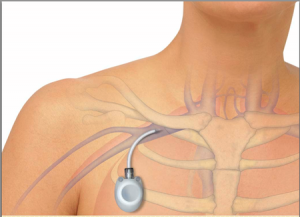
Having a port is a godsend when you are going through Chemotherapy. From the moment one is diagnosed with cancer, your veins are going to be in for a major breakdown. In my case, my veins are very tiny and very deep in my arm joint. It makes it extremely difficult for a technician to access my veins. Many times I have been poked 6-12 times trying to get a needle into my vein. Sometimes one is successful, but more times than not, one is not successful and I am left feeling like a pincushion! Some technicians, if really good, can access my vein after a couple of tries. But that is the exception more than the rule. Because of this, I knew that a port was the only answer for me!
I have already talked about the experience of getting the port put in. But there is a lot more to learn when dealing with a port. A port has to be flushed each time you go in for treatment. It has to be flushed BEFORE drugs are administered to make sure that the drugs will flow into your system the way the are meant to. If the port is clogged or blocked in any way, the drugs will not be able to move through the tube into your system. Also, if it is clogged, it can cause leakage. In some cases, it can cause serious problems for the patient. Depending on the drugs, some of the drugs are highly toxic and if they spill onto your skin, can cause adverse reactions. Who needs that with all these other things to worry about?
Getting Your Port Flushed
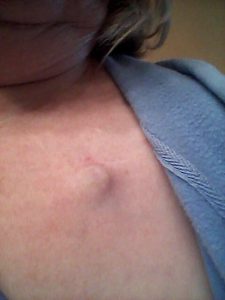
Also, a port then has to be flushed when you finish with the drugs. Again, the port needs to function every time it is needed. Getting a port flushed is not really a big deal. It does take a little getting used to, though. Because the port lies under the surface of the skin, when the needles are inserted into the port, it can be very painful! The needles are quite large and if they are inserted into the port without medication, it can really, really hurt. I have a very high threshold for pain, but I do have to say that those needle insertions by themselves were very painful!. But there is a solution!
My doctor called in a prescription for Lidocaine Creme. It comes in tiny little tubes, and I think the minimum you can get is two tubes. You can also get up to 6 tubes at one time. What you decide to get usually depends on how much money you have available. Also, I discovered that one of those tiny tubes will last quite a long time. I could get my tubes to last 3 to 4 months.
Using Lidocaine Creme with a Chemotherapy Port
Exactly how do you use the Lidocaine Creme you ask? Here are the instructions I was given and they work very well.
1) Clean the area over the port
2) Cut a piece of plastic bag or saran wrap at least 2″ X 2″ to put over the area AFTER you apply the creme3) I take medical tape and go ahead and put it across the top and the bottom of the plastic bag/saran wrap
4) Unscrew the lid of the Lidocaine Creme, take a q-tip, and apply a large dollop of creme to the tip of the q-tip
5) Try not to contaminate the creme – only apply one dollop to one q-tip and then apply the creme on the tip of the q-tip to the raised area of the port. You want to try and cover the entire raised area, but especially the middle of the raised port area. Most nurses try to insert the needle into the middle of the port
6) It is advised to apply the Lidocaine Creme to the port area approximately 30 to 45 minutes before your appointment. You will have to try and judge this based on how long you typically have to wait for treatment once you arrive at the Infusion Clinic. The purpose of the creme is to NUMB the area where the needle will be inserted. Just so you know, just numbing the area does not eliminate all of the pain!
7) Once you are escorted to your chair in the Infusion Clinic, the nurse will drape you and remove the plastic bag/saran wrap from the area covered with creme. They usually do this after they are all set up to flush your port. Here is the trick to no pain: The nurse will usually count to three. On three, you take a deep breath and that is when they insert the needle. If the timing is right, you will feel very little if any pain!! It seems hard to believe, but for someone who has been stuck hundreds of times, I can tell you this really works!
8) Once you have finished Chemo, this process will be repeated, but in the reverse. The port will be flushed with saline, and then the needle will be removed. Again, it helps to take a deep breath when the needle is being removed. The nurse will then put a band-aid or gauze over the area. It is a good idea to leave this on for several hours. I usually leave mine on overnight just because I do not want any contamination from my clothing.
I hope this article has answered some questions for you. These were my experiences. However, if there is something you do not understand or need more information on, I may be able to help you. PLEASE leave me a comment or message. I will get back to you!


